




















2025 – LOOKING BACK, TO LOOK AHEAD
2025 – LOOKING BACK:
TO LOOK AHEAD
Millions in America and throughout the world began 2025 with dread. We faced the start of another Donald Trump presidency, genocide in Gaza, and job displacement from A.I. and other technologies. Things soon got worse than expected, as fires and floods ravaged some cities, Trump sent the Border Patrol and military to attack others, and a government shutdown snatched food from hungry children without achieving any reforms.
However, a mighty anti-fascist movement also arose in 2025. Millions took to the streets nationwide, shouting “No Kings” at the president and his elite backers. As the year ended, an army of 100,000 volunteers spread out and convinced one million New York voters to elect Zohran Mamdani as their mayor. He became the city’s first African-born, openly socialist mayor.
Now is a good time to reflect on what happened this year, to discern the next steps in the class struggle.
LESSONS OF 2025
In 2025 America became a war zone because President Trump sent an armed, masked army into the streets. Claiming to be hunting undocumented criminals, their raids terrorized whole communities of working class people. Immigrants died in detention centers and also while fleeing into traffic, such as Josué Castro Rivera in Virginia and Carlos Roberto Montoya in California. The modern-day Storm Troopers not only shot immigrants like Silverio Villegas González, who was killed after dropping his kids at school in an Illinois suburb. They also shot U.S. citizens Marimar Martinez in Chicago and Carlos Jimenez in Ontario, California.
Americans of all nationalities and colors are challenging this attack, which many see as one step within a political offensive to impose fascism upon the country. Our November article Bay Area Defeats Border Patrol Surge (https://rally-theleague.org/bay-area-defeats-the-border-patrol-surge/) applauded the activists whose quick mobilization in October worried local capitalists into asking Trump to pause the attack. On October 29 Mission Local news reported on immigration arrests in San Francisco since May, “the vast majority at the courthouses or ICE field office.” But they found that as the movement grew, there had been no further arrests of immigrants at immigration courts since October 3.
Activists in the Bay Area and across the nation had also been energized by the October 18 No Kings protest, which turned out 7 million people against the Trump administration’s many attacks on the people. Our article noted that No Kings “includes very diverse elements, all the way from working class revolutionaries to shameful apologists for corporate Democrats, whose failed policies laid the foundation for MAGA’s rise to power in the first place”. The article concludes that “In the long run, they will have to more fully embrace class demands like those advanced by the Workers Over Billionaires trend within it.”
Part of that effort is taking place within the electoral arena, where broad public support for restoring health care benefits encouraged Democrats to withhold enough votes that a new federal budget couldn’t be passed. That caused the longest federal government funding shutdown in American history, until some Democrats voted with Republicans to pass a budget without the health care assistance. That betrayal is fueling the new kinds of political movements.
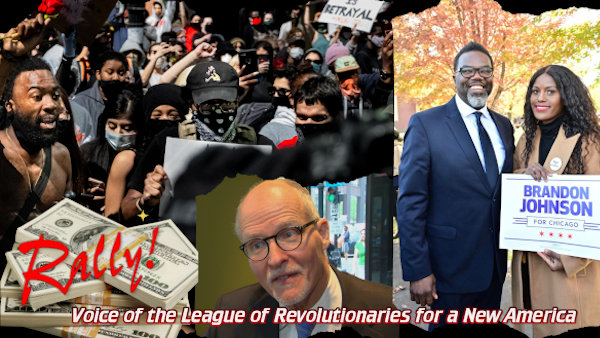
Our article A New Urban Movement: Public Wealth For Public Good (https://rally-theleague.org/a-new-urban-movement-public-wealth-for-public-good/) explained how activists in Chicago and New York are proposing that the resources and assets owned collectively by the public should be utilized in ways that benefit society as a whole. In Chicago, the pressure is building for the city to become “a developer of green, affordable housing – reclaiming land and labor for the public good.” In New York, Zohran Mamdani became the city’s first socialist mayor, with a platform calling for city-run grocery stores and fare-free transit.
The significance of these two struggles is that “These represent a growing refusal to accept the capitalist premise that public institutions must serve private interests. Instead, they ask: What if the city itself became the builder, the provider and protector – not in order to extract profit, but to deliver justice?” Our writers conclude that “Whether this is the beginning of a revolutionary transformation depends on what happens next”.
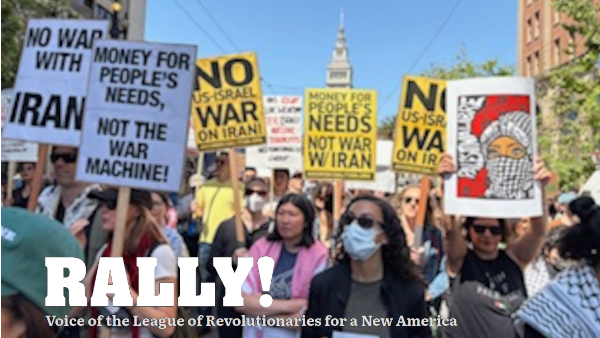
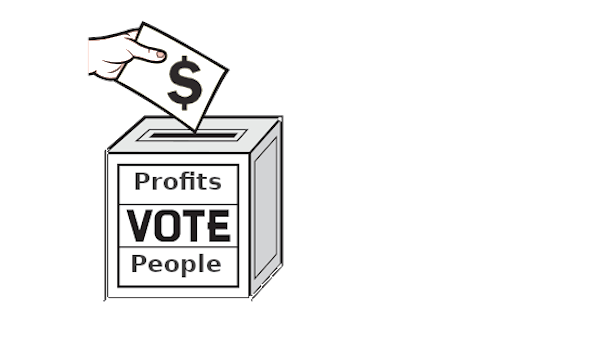
Part of that includes how the people respond to the increasing war dangers the government has provoked in Latin America and the Middle East. After Trump sent bombers over Iran in June, we warned that Bombing Iran Worsens Suffering in the U.S. and Abroad (https://rally-theleague.org/bombing-iran-worsens-suffering-in-the-u-s-and-abroad/). “The bombs that Trump aimed at Iran’s nuclear science facilities were also intended to intensify fear and hatred among America’s people, to keep us divided and fighting each other instead of them. Last week he raised fear against immigrants. Last month against the Palestinian people and students living here. Today it’s Iranians. … Our fight isn’t with workers overseas. Our fight is with the system that puts profits over people, everywhere.”
It is crucial that our class understand the way corporate misuse of new technology pushes the ruling class towards implementing a new fascist system. In May, Working Class Power in the Age of AI and Technofascism
(https://rally-theleague.org/working-class-power-in-the-age-of-ai-and-technofascism/)
explained that “The elimination of human labor creates a political dilemma for the ruling class. How to control – or eliminate – the surplus workers left behind? The spread of genocide today is not an accident in places like Palestine, Yemen and Sudan. In the United States, it is reflected in the trend toward mass deportations, mass incarceration, and internment camps for unhoused people. It is the driving force behind today’s fascist offensive.
COLLECTIVE ACTION FOR SOLUTIONS
But it does not have to be this way. If workers controlled this technological revolution, it could produce an inexpensive abundance of basic needs, eliminate drudgery, solve pressing social problems and liberate humanity from unnecessary toil. The question is how to gain that control. That question was also a focus of the article From the Defensive to the Offensive Against Fascism (https://rally-theleague.org/from-the-defensive-to-the-offensive-against-fascism/).
The January firestorm in the Los Angeles area burned over 16,000 structures while killing at least 27 people. Many also lost their jobs and businesses. Politicians blamed the 80 mile per hour winds and 2024 being the hottest, driest summer in the city’s history. A different analysis came in our February article Angelenos fight wildfires, capitalism’s vultures (https://rally-theleague.org/angelenos-fight-wildfires-capitalisms-vultures/):
“High winds, hurricanes, floods and dry conditions have come and gone for thousands of years, but now they’re whipped into unprecedented disasters through climate change. Scientists around the world have verified that climate change was provoked by industrial capitalism’s deadly levels of carbon emissions.” The article explained how “The fight for immediate shelter and survival then quickly became a fight for future reconstruction in the interests of the public as developers and financiers prepared to profit by gentrifying burnt communities.”
We began 2025 with January’s Private Healthcare Insurance Kills (https://rally-theleague.org/private-healthcare-insurance-kills/), which reported that “On January 10 5,000 nurses, doctors, midwives, and nurse practitioners launched a strike against under staffing at Providence Health and Services, the largest hospital chain in the Pacific Northwest…This growing movement is not just about fixing a broken healthcare system; it’s about dismantling the root cause of the crisis—private ownership of the resources and wealth that sustain life.”
“The failure of the current system to provide care for all is a symptom of a society where corporations dictate the terms of survival, extracting profits from human suffering while abandoning those who no longer serve their interests. The movement for universal healthcare is a powerful example of how collective action can challenge corporate power and inspire hope. From successful campaigns to eliminate medical debt to state-level pushes for universal healthcare programs, these fighters are showing what is possible when people come together.”
Published on December 1, 2025
This article originated in Rally!
P.O. Box 408002 Chicago, IL 60640 rally@lrna.org
Free to reproduce unless otherwise marked.
Please include this message with any reproduction.
Websites




https://shorturl.fm/5ddtb
https://shorturl.fm/v8DQo
https://shorturl.fm/ND00t
Alright, so I stumbled upon biabettelegram. Seems like a useful Telegram channel. If you’re into mention relevant topics based on assumption, e.g., sports betting tips, give it a look! biabettelegram
https://shorturl.fm/veJke
https://shorturl.fm/EbZ82
https://shorturl.fm/WqEHW
https://shorturl.fm/hpEYf
https://shorturl.fm/IQrAP
Earn passive income with every click—sign up today!
That’s a great point about balancing risk & reward! Seeing platforms like funph slot offer diverse games (fishing, live dealers) really shows they understand player preferences & RTP is key! 👍
It’s interesting how quickly online casinos are adapting to local markets! Seeing platforms like kkkph com focus on the Philippines with apps & tailored games is smart. Accessibility is key – easy sign-up is a big plus for new players!
Partner with us and enjoy recurring commission payouts!
Drive sales, earn commissions—apply now!
Share our products and watch your earnings grow—join our affiliate program!
Hey, quick heads up about ok36524. It’s not too shabby. User-friendly if that’s what you’re after. Check it out! ok36524
Alright, Reddybookbet fam! Just wanted to chime in and say I’ve been placing some bets here. The odds seem pretty decent. Give it a shot if you’re feeling lucky! Place your bets at reddybookbet
Yo, vn138 crew! Been hanging out on this site for a while. It’s got a good vibe and plenty of options. Definitely worth checking out when you wanting some action! Jump in to vn138
Start earning on every sale—become our affiliate partner today!
Share our products and watch your earnings grow—join our affiliate program!