
















































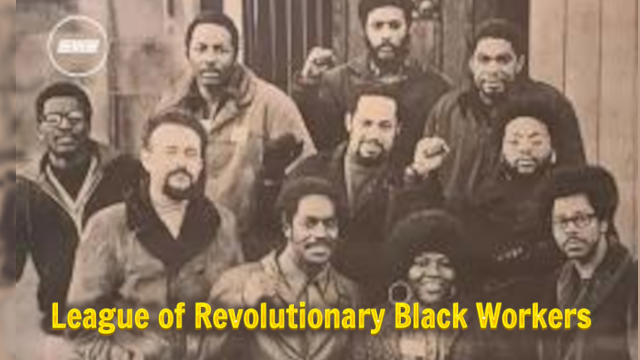
New History of Detroit LRBW Challenges Us To Think Ahead
League of Revolutionary Black Workers
New History of Detroit LRBW
Challenges Us To Think Ahead
A new history of the Detroit League of Revolutionary Black Workers challenges revolutionaries to assess the 1960s and ’70s and determine what is different today and how to respond.
In September 2025, the University of Georgia Press published “Motown and the Making of Working-Class Revolutionaries: The Story of the League of Revolutionary Black Workers” by Jerome Scott and Walda Katz-Fishman. Scott was a leader of the LRBW fired from the Chrysler Detroit Forge plant after helping lead a wildcat strike against unsafe conditions in 1973. Katz-Fishman is a scholar-activist and professor of sociology at Howard University who has worked closely with former members of the LRBW since she attended Wayne State University in Detroit in the 1970s.
The publishers say “Motown” offers “a fresh perspective on class, race and revolution in the United States.” The book is both a collective oral history and a deeply researched examination of the rise and decline of the Detroit auto industry and its consequences.
Scott and Katz-Fishman have assembled interviews with 40 people who took part in an LRBW oral history project begun in 2016. Many were LRBW activists. Others helped the LRBW members in some way – lawyers, student activists, and revolutionaries from outside Detroit who worked with former LRBW members in other revolutionary formations after the LRBW’s end.
The book is an inspiring collective historical record of committed revolutionaries grappling with how to adapt to a changing world and assessing how to push forward the revolutionary process today.
The former members of the LRBW recount the horrific conditions in the auto plants, the challenges the LRBW faced, and the long struggle to build other revolutionary organizations after the LRBW split in 1971. To their credit, the people interviewed do not simply reminisce – they reflect deeply on what the hard-fought battles of the 1960s mean for today. They are frank and self-critical about mistakes that were made – particularly about the way women were treated in the LRBW. They are brutally realistic about how different the economic and political conditions are today.
The people who were interviewed describe how revolutionaries who began their political lives in the LRBW went on to join other revolutionary organizations after the LRBW split in 1971. First, they joined the Communist League in 1972. Then they helped found the Communist Labor Party in 1974 and ultimately they helped create the League of Revolutionaries for a New America in the 1990s.
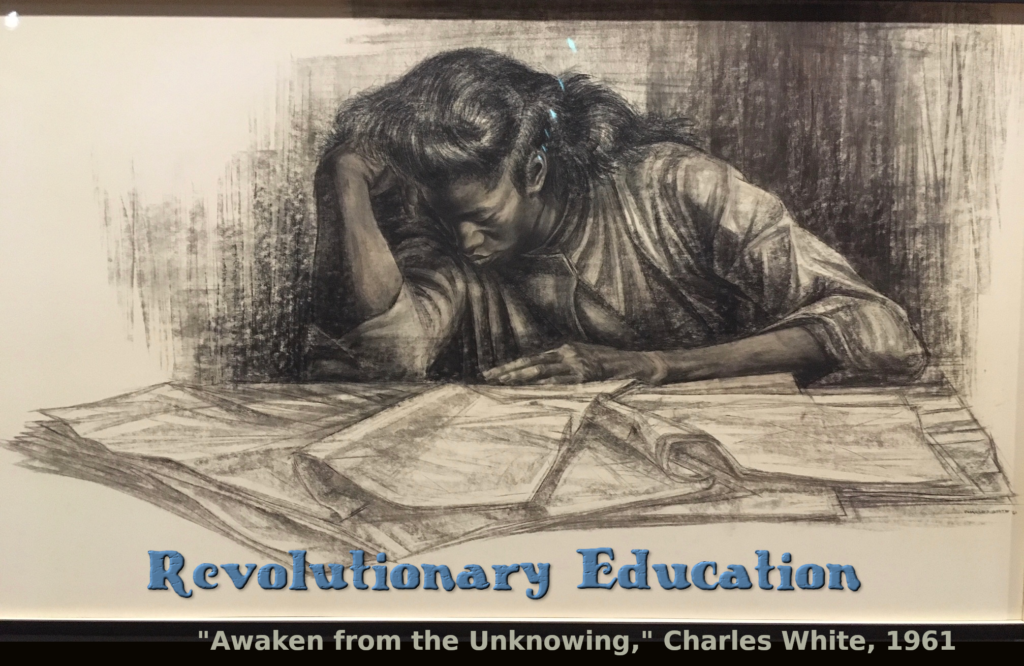
Again and again, those interviewed stress the importance of political education. After the LRBW split, the working-class members of the LRBW embarked on a concentrated period of deep theoretical and political study. This intense study of the history and theory of revolutions has continued ever since. It’s what has allowed the veterans of the LRBW to make sense of the profound changes since the 1970s and to continue contributing to the revolutionary movement ever since.
FILLING A VOID
“Motown” is the first history of the LRBW created by members and allies of the LRBW themselves. Few studies of the LRBW exist, despite the fact that the LRBW was one of the most significant organizations to emerge in the late 1960s. The few that do were written by academics who were not part of the LRBW.
AUTO INDUSTRY’S RISE AND DECLINE
The authors point out that it was no accident that Detroit was home to the LRBW’s evolution. During the first half of the 20th century, Detroit was the epicenter of world auto production. The massive expansion of the U.S.auto industry brought workers from all over the world. This was the context for the rise of the LRBW — black workers at the point of production responding to the brutal exploitation and white supremacy of that moment.
The book describes the rise and decline of the U.S. auto industry, emphasizing technological change — from the first assembly line in 1913 to the introduction of robots and automation in the 1960s and ’70s.
Having laid this objective economic foundation, the book then allows the former LRBW members to tell their stories of how the organization emerged, why it split, and what happened afterward.
The authors point out that “the violent state repression by the police, National Guard and army to quell the working-class uprising during the [July] 1967 Detroit Rebellion and the wildcat strike at Dodge Main in 1968 together sparked a critical working-class reaction.” Within a year after the rebellion and wildcat strike wave, the Dodge Revolutionary Union Movement (DRUM) was born. Other Revolutionary Union Movement groups soon followed. The need for an umbrella organization for the different RUMs soon became clear, and the LRBW was formed.
The book describes how many of the key leaders of the LRBW such as General Baker, John Williams, Mike Hamlin, Luke Tripp, Chuck Wooten, Ken Cockrel, and John Watson met up in the early 1960s. It recounts the important struggles they led including major wildcat strikes. These leaders reflect on the strengths and limits of wildcat strikes. As the book explains: “Strikes called by the union required ninety days’ notice to the corporation, allowing it to stockpile needed parts and prepare. Wildcat strikes … were called by the workers without union agreement or negotiation with the company.”
This book should be read widely and studied by revolutionaries. It can and should be used as a model for revolutionaries in other cities to sum up experiences in the 1960s and ’70s, and assess what to do now.
# # #
For information about how to obtain a copy of this important book, go to:
Published on December 1, 2025
This article originated in Rally!
P.O. Box 408002 Chicago, IL 60640 rally@lrna.org
Free to reproduce unless otherwise marked.
Please include this message with any reproduction.
Websites




https://shorturl.fm/9srhM
https://shorturl.fm/ZT29a
https://shorturl.fm/nhifs
https://shorturl.fm/P53Mk
Trying to find a decent sports stream can be a nightmare! Has anyone had any luck with selcuksportshd7? I’m not expecting miracles, just something that’ll let me see the game! selcuksportshd7
https://shorturl.fm/5Njz5
https://shorturl.fm/BxFqC
https://shorturl.fm/R9Dc2
https://shorturl.fm/PRzs2
https://shorturl.fm/8oDEU
https://shorturl.fm/Cd0vo
https://shorturl.fm/w9dpc
https://shorturl.fm/P5HqW
https://shorturl.fm/w59Sa
https://shorturl.fm/FkJud
https://shorturl.fm/MhCVp
https://shorturl.fm/HvPQ7
https://shorturl.fm/RKfqP
https://shorturl.fm/dtvnq
https://shorturl.fm/yaqoV
https://shorturl.fm/X8xGp
https://shorturl.fm/trH3F
https://shorturl.fm/IPTz2
https://shorturl.fm/oh2Sq
https://shorturl.fm/bzfKW
https://shorturl.fm/t4yxI
https://shorturl.fm/dZ70A
https://shorturl.fm/DSBFW
Baccarat strategy is fascinating – understanding patterns can help, but discipline is key! Seeing platforms like cardtime slot download offer diverse games & quick PHP transactions is a big plus for accessibility too. Solid security features are essential!
https://shorturl.fm/gXeOD
Hi https://is.gd/9PLRLO
Start earning passive income—join our affiliate network today!
Analyzing baccarat patterns is key, but a solid platform matters too. Seeing the focus on secure access & verification at 49jili.click is reassuring. Check out the 49jili app download for a streamlined experience-discipline & a good site are a winning combo!
Earn recurring commissions with each referral—enroll today!
Turn referrals into revenue—sign up for our affiliate program today!
It’s fascinating how quickly online gaming evolved in Asia! Platforms like 365 jili casino really show that shift, offering everything from slots to live dealers. Account security & verification are key these days, a smart move for players & platforms alike!